
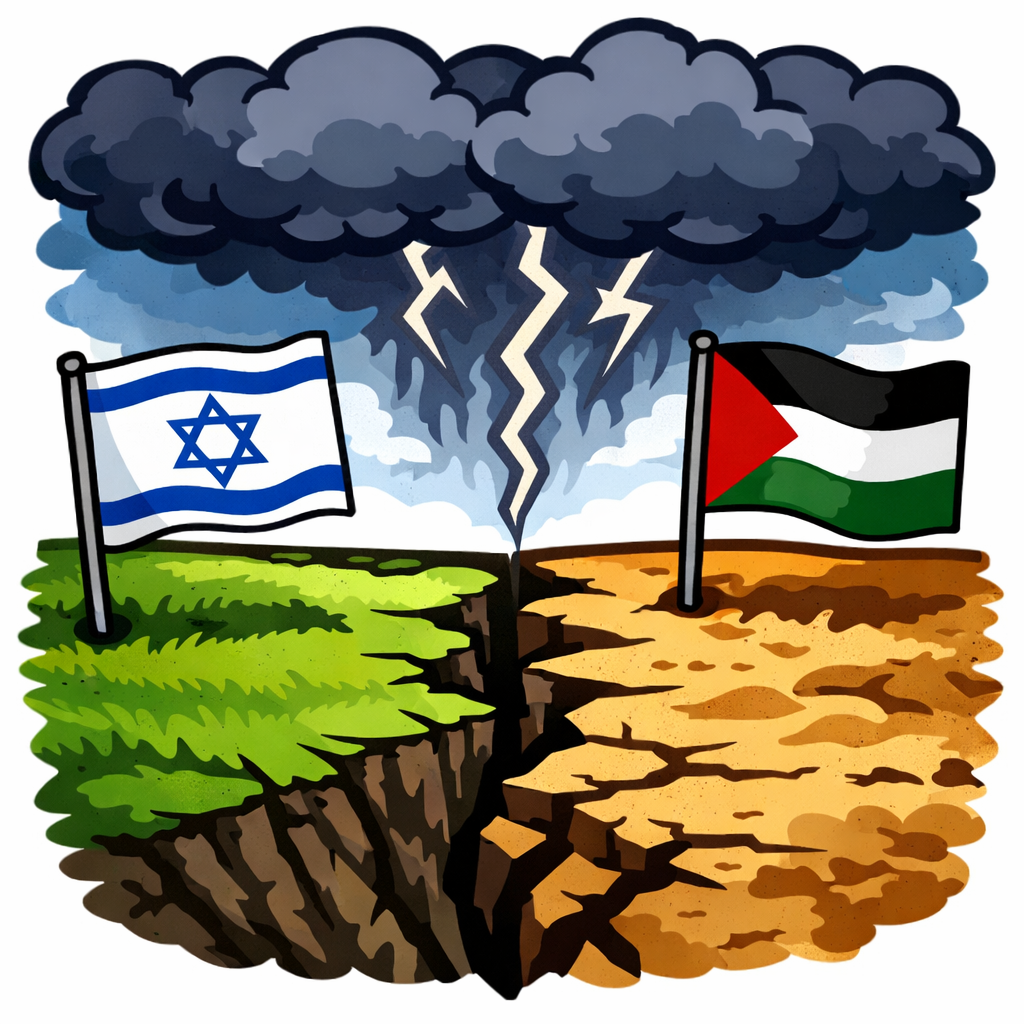
Now that we have examined the biblical case for the land apportioned to Israel, the next questions that naturally arise are these: Where, then, should the Palestinians go? Who exactly are they, and were they always there? Where were Jews living before the conflicts began? And why, despite all this, is agreement so elusive? To answer these questions, we need to take a deep dive into history.
Historically, Judea was the homeland of the Jewish people and the name used during the Second Temple period. In AD 135, however, under the reign of Emperor Hadrian, the Jews revolted against the Roman Empire. Rome crushed the rebellion, and as punishment—aimed at severing Jewish national identity and their connection to the land—Hadrian renamed Judea Syria Palaestina. He also renamed Jerusalem Aelia Capitolina and banned Jews from entering the city, except for one day each year.
Why Palaestina, you may ask? Hadrian derived the name from the Philistines, an ancient and long-extinct enemy of Israel, deliberately choosing it to spite the Jews. This was not the name of an Arab or Muslim people, nor did it have any connection to modern Palestinian Arabs, who emerged centuries later.
So when did the Palestinian nation begin? History indicates that a distinct modern Palestinian national identity emerged in the early 20th century. Prior to this, the people living in the land identified primarily as Arabs, Southern Syrians, Muslims or Christians, and as members of clans, villages, or the Ottoman Empire rather than as “Palestinians” in the modern national sense.
This began to shift significantly during the British Mandate period (1920–1948), when the territory was organized as a defined administrative unit. During this time, the term Palestinian was used to refer to both Arabs and Jews living in the land. A distinct Arab Palestinian nationalism then developed largely in reaction to Zionism and in response to British rule—it was, in many ways, a reactive movement.
In 1964, the founding of the Palestine Liberation Organization (PLO) marked the crystallization of this identity. For the first time, there was a clear, organized, and internationally recognized political expression of a distinct Palestinian national movement. It is important to note that this occurred before Israel took control of the West Bank and Gaza, which happened three years later in 1967. This fact challenges the claim that Palestinian nationalism arose solely as a response to “occupation.”
What this means is that Palestine existed historically as a geographic designation—first imposed by Rome and later reused by successive empires. The modern Palestinian identity is real, but it formed in the 19th and 20th centuries, not as an ancient nation-state. Acknowledging this does not deny Palestinian humanity or suffering; it simply keeps the historical record honest.
So where were the Jews living before all this? Jews had been dispersed across many regions of the world, while also maintaining a continuous presence in the land known as Palestine during the British Mandate. By that period, Jews constituted roughly a third of the population within that region. After World War II and the murder of over six million Jews in the Holocaust, the United Nations supported the establishment of the State of Israel, seeking to provide the Jewish people with national self-determination and a means of collective security.
After the Holocaust, Jewish survivors—many of whom had been displaced from various European nations—began returning to the newly established State of Israel. Arabs who had been coexisting with Jews in the land increasingly resisted this influx, and tensions escalated into open conflict. Soon after Israel’s declaration of independence in 1948, surrounding Arab nations went to war against the infant state.
Remarkably, Israel— without clear military superiority—emerged victorious and secured its independence.
Prior to this, the United Nations had proposed a two-state solution: one state for the Jews and one for the Arabs. The Jewish leadership accepted this proposal, but the Arab leadership rejected it. Instead of coexistence, violence and civil war followed, forcing Israel into a defensive war.
One tragic result of this conflict was the displacement of over 700,000 Arabs, many of whom fled or were driven into refugee camps in neighboring Arab countries and in the Gaza Strip. This was undeniably a painful outcome of the war. However, it must be understood in the context of a conflict initiated by those who openly sought the destruction of the Jewish state. Had the UN proposal been accepted, much of this suffering could have been avoided.
Jews, too, were a people under existential threat. Having just endured the murder of over six million of their own in the Holocaust, the survivors had nowhere else to go but home. Yet even there, they were not welcomed. When asked to coexist, the response was war. Faced with annihilation, what exactly were the Jews supposed to do?
Much happened afterwards in repeated efforts to secure peace, but none of them bore lasting fruit. The Palestinian Authority was eventually overthrown in Gaza by Hamas, an Islamist organization. Hamas’ primary objective has never been limited to gaining self-governance from Israel in places like the West Bank. Rather, their central aim—clearly stated in their founding charter—is the destruction of the Jewish people.
When Hamas says “Free Palestine,” they do not mean peaceful coexistence or Palestinian self-determination; they mean the elimination of Jews. To them, the ideal outcome is- No Jewish state at all! Their actions have consistently demonstrated this. Did you know that Hamas’ charter mentions Islam more than 140 times, while the word Palestine appears zero times? That alone reveals their true motivation. This is not a movement driven by concern for Palestinian civilians, but a jihadist ideology committed to the annihilation of Jews.
October 7, 2023, changed everything. On that day, over 1,000 Hamas fighters infiltrated the borders of Israel and carried out a brutal, indiscriminate attack. They murdered civilians, committed sexual violence, and took hostages. Many of these atrocities were recorded by the perpetrators themselves and are available online for all to see. They celebrated as they killed innocent men, women, and children as they shouted “Allahu Akbar”. The aftermath revealed scenes so horrific that no honest observer can walk away unchanged—families slaughtered, children murdered, and entire communities devastated. More than 1,200 Israelis were killed before the IDF regained control.
Anyone who has truly seen the evidence cannot emerge defending such evil. Israel had—and has—the right to respond. Every democratic nation reserves the right to self-defense when attacked.
Now, let’s talk about the war that followed October 7th. Intelligence gathered by Israel revealed that Hamas had invested millions of dollars in constructing hidden tunnels beneath civilian residential buildings, schools, and hospitals. They also positioned rockets strategically in front of these same schools and hospitals, fully aware that any Israeli retaliation could hit these locations. Their goal was two-fold: either to make Israel hesitate in defending itself seeing that many civilians would die, or to provoke international condemnation when media footage showed schools or hospitals being struck.
It’s shocking just to think about it. Did you know that the Israeli government would warn Palestinian civilians to evacuate an area before targeting it, yet Hamas would intentionally prevent them from leaving, forcing people to remain in these locations to display so-called “solidarity”? Many innocent Palestinians, including children, have died because of this. This is horrific and saddens me to the core. But if anyone is to blame, it’s Hamas—they are the root cause of all this.
The way the media has managed to coin language to vilify the Israeli government for defending itself makes me wonder: have we forgotten what these evil people did on October 7th, or have we developed a one-sided sense of humanity that chooses where to place its concern? So many children and innocent people have died in Israel, just as they have in Palestine. That is the tragic reality. But we must remember who started all this—Hamas are the villains.
There are also many reasonable Palestinians who stand with Israel because they have witnessed, firsthand, the destructive and narcissistic behavior of Hamas. When you see pictures of dead Palestinian children, that responsibility lies with Hamas. War is ugly. It is horrific. But the unfortunate reality of war is that it results in civilian casualties. International law establishes rules around what is considered “acceptable” civilian losses—but this war has trampled all those laws. When civilians and vulnerable children are intentionally put in harm’s way, that is not just unfortunate—it is evil.
Can there ever be peaceful coexistence between Jews and Arabs? Not as long as Arab nations are led by Islamist jihadists. They are unreasonable, and their goal is not peace—it is the annihilation of all Jews. Tragically, their own fellow Arabs often pay the highest price for this ideology as well.
Biblically, we see a pattern of those who have sought to destroy the Jewish people. The book of Esther provides a clear example: Haman plotted to annihilate all Jews, yet God intervened and delivered His people. God will always fight for His own, and He is also deeply concerned for the vulnerable, innocent people caught up in this war—He cares for them too.
As for those pro-Palestinian activists who are quick to share images of innocent children killed in the conflict and use them to fuel hatred against Jews, I would urge you to first check all the facts. Begin by understanding exactly what happened on October 7th against the Jews. If, after examining the truth, you still align yourself with Hamas, then your problem is deeper—it is not about concern for humanity. What you are standing for is not justice or compassion, but hatred for an entire people, simply for exercising their right to survive.
All Christians should take this upon themselves and commit this conflict to the Lord in prayer. Pray that even in the midst of this ugly mess, God will bring about a favorable outcome. Remember, the Lord is never short of ways to accomplish His will. He will protect the Jewish people, as well as all vulnerable civilians in Palestine.